

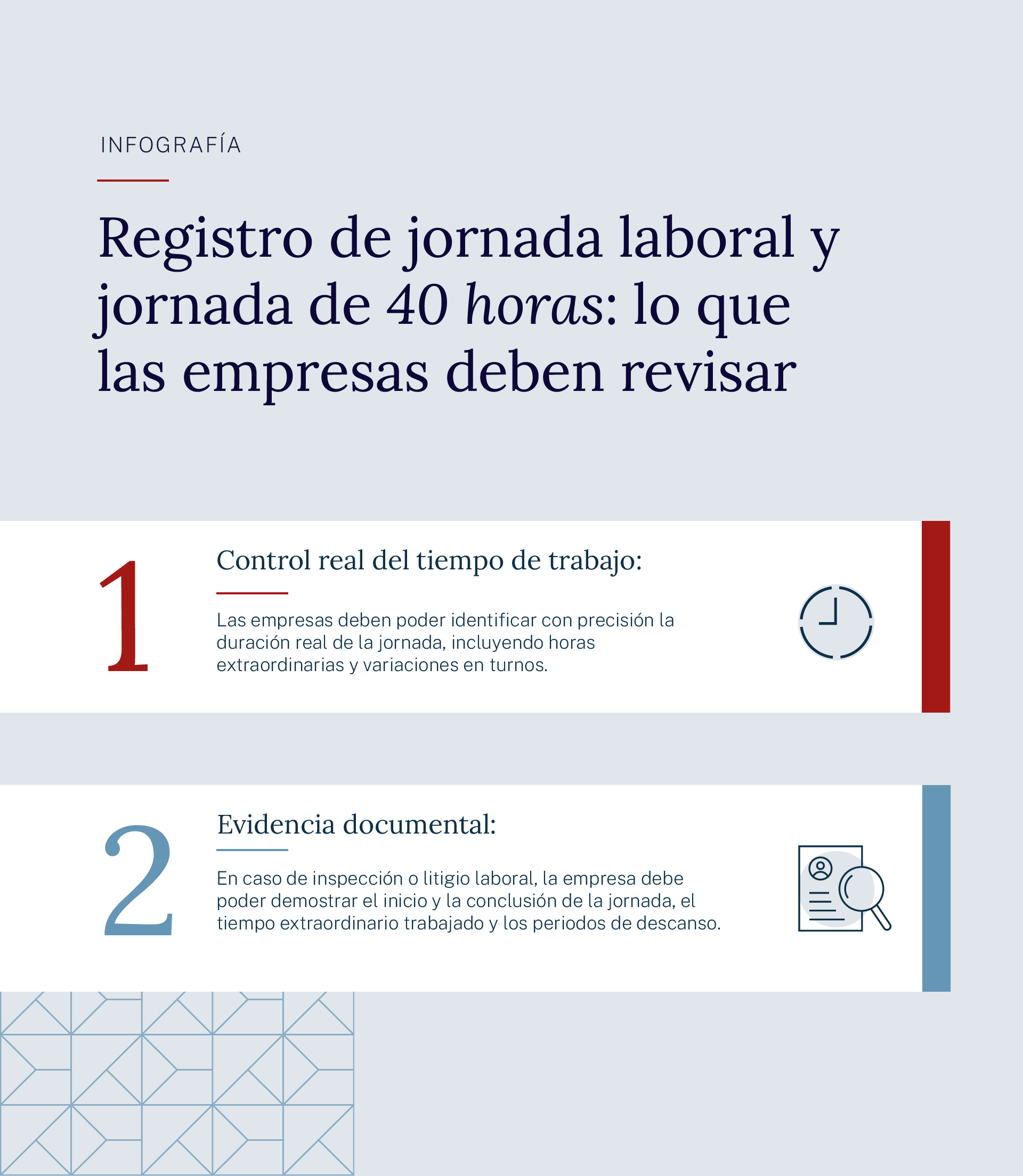
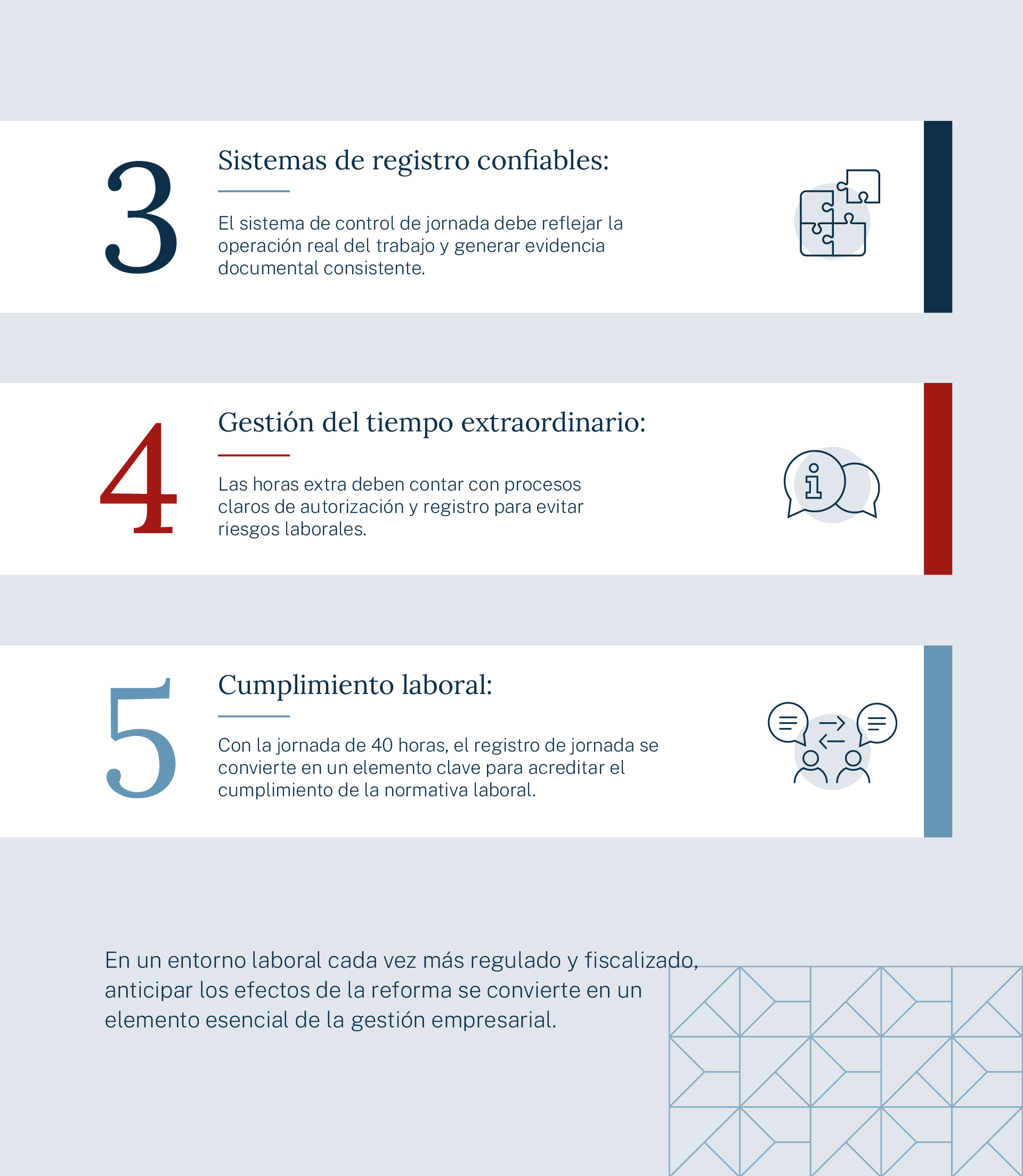
Mexico's phased reduction in working hours calls for a closer review of how employers document time actually worked. A clock-in and clock-out record may be useful, but it does not automatically explain a late handover, a corrected entry or a discrepancy between recorded hours and payroll.
Legislation published on May 1, 2026 introduced electronic working-time records into Article 132 of the Federal Labor Law and provided for a gradual reduction of ordinary weekly hours from 48 in 2026 to 40 by 2030, with the first step to 46 hours in 2027. The general rules through which Mexico's Ministry of Labor (STPS) will define coverage and exceptions are scheduled to take effect from January 1, 2027. Read the official decree.
For employers, the challenge extends beyond choosing technology. It is to connect agreed working time, actual records, authorizations and payroll so that differences can be understood during an internal review, labor inspection or employment dispute under the applicable rules.
Reliable evidence emerges when what happens in the business can be reconciled with schedules, authorized changes and pay. Software alone cannot replace the people reviewing discrepancies.
What the 2026 reform provides and which details require STPS rules
The Federal Labor Law reform took effect on May 1, 2026. The new Article 132(XXXIV) addresses electronic records of working time for each employee, including the start and end of the working day, and providing the records to the authority when requested. It also calls for STPS general rules defining which employers are covered and any exceptions.
Under the fifth transitional provision, those general rules are scheduled to take effect from January 1, 2027. It is therefore important to distinguish the statutory provision from technical or scope requirements that depend on implementing regulations. The reform does not itself establish one mandatory time-clock device, app or platform for every employer.
Article 994(IV Bis) also provides for a penalty for employers who fall within the obligation and fail to comply. Whether the provision applies in a given case requires an assessment of the implementing framework and the employer's circumstances, not an assumption that every business is subject to identical technical conditions.
Article 132 introduces electronic working-time records and the period for adjusting work processes.
STPS general provisions are scheduled to take effect; the ordinary weekly ceiling becomes 46 hours.
The phased reduction reaches its final ordinary weekly maximum.
Article 132(XXXIV) establishes the basic electronic record and disclosure to the authority when required. Other controls are operational choices subject to applicable requirements.
What the law specifies and which additional controls may be useful
Article 132(XXXIV) expressly refers to electronic records by employee, the start and end of working time, and making the information available to the competent authority when required. Those are the legal reference points stated in the amended provision.
Employers may find it useful to record additional matters such as breaks, handovers, overtime, incidents, approvals and changes. These operational fields help with workforce management, documentation and payroll, but they should not be presented as a universal statutory specification for the new electronic system before the relevant STPS rules and individual circumstances are considered.
Controls should reflect the workplace, the contract and the appropriate handling of personal information. A traceable correction is more useful than silently overwriting a clock entry. Automated scheduling records should likewise not obscure work that actually occurred under a manager's instructions.
Matters expressly stated by the reform
- Electronic record for each employee.
- Start time of the working day.
- End time of the working day.
- Disclosure to the authority when legally requested.
Additional employer controls
- Changes to shifts and handovers.
- Breaks and verifiable incidents.
- Additional work, approvals and pay.
- Corrections with explanations and accountable owners.
What electronic records can prove—and what requires legal assessment
In an employment dispute, records may help establish actual hours worked, the treatment of overtime and whether payroll aligns with the activity performed. Mexico's Federal Labor Law contains requirements concerning record retention and allocation of evidentiary burdens; their application depends on the facts and the particular claim.
In its 2017 decision, jurisprudence 2a./J. 36/2017, Mexico's Supreme Court differentiated specific claims relating to up to nine hours of weekly overtime and amounts beyond that threshold. It should not be read as a universal burden-of-proof rule regardless of the period, subsequent legislation or available evidence.
The 2026 reform introduced a further provision: the contents of an electronic record have full evidentiary value if it is established that they were agreed between the employee and employer. That condition matters. An employer cannot assume that a unilateral software setting or an electronic file without context automatically produces the same legal effect in every dispute.
Record start and finish through the applicable method.
Review incidents and adjustments without erasing work performed.
Compare records with schedules, approvals and payroll.
Retain reliable information under proportionate access controls.
The law makes full evidentiary value conditional on proof that the electronic record was agreed between the employer and employee. Its effect in a particular dispute still requires legal assessment.
When the time clock, the manager and payroll tell different stories
A common issue is not a total absence of records. The roster may show the planned schedule, while a manager's message or a late handover suggests additional activity. The business then needs to determine whether work took place, for how long and how it should be treated under the relevant employment rules.
The following is an illustrative scenario, not a case involving DLVMR or one of its clients. It does not, by itself, prove overtime; it demonstrates the different sources an employer may need to reconcile before reaching a conclusion.
Hypothetical differences between a planned shift, later communication and the information received by Payroll.
08:00–16:00
The team's roster shows a planned eight-hour period.
Message at 17:15
A work-related message appears later. By itself, it does not establish how long anyone worked.
No automatic conclusion
Actual work, duration, approvals and applicable pay still need to be verified.
On-site, shift-based and flexible work demand different recording methods
A suitable system depends on how the work is actually performed. On-site workplaces may use access records and job-completion information. Shift-based operations need to account for handovers, rotations, absences and extensions. Hybrid or remote arrangements require workable ways to record actual starts, finishes and exceptions without disproportionate employee surveillance.
Employers should examine whether data from different locations can be compared with agreed terms and payroll. A system that merely copies the planned roster into a timesheet does not necessarily record the variations that arise in real operations.
Working-time records complement, but do not replace, shift planning. For operating coverage, read our article on the 40-hour workweek and shift continuity. For a deeper discussion of statutory coverage, exceptions and regulatory requirements, see DLVMR's electronic working-time records guide.
On-site
Reconcile clock records, manager instructions, incidents and actual hours.
Shift-based
Account for changed shifts, extensions, on-call duties and actual coverage.
Flexible or remote
Set reasonable recording procedures for variable hours without indiscriminate surveillance.
The exposure created by inconsistent hours, incidents and pay
Inconsistent documentation may complicate an employer's response to labor inspections or overtime disputes. Sometimes several tools exist but none accounts for an entire incident: a manager authorizes an extension, an employee records different hours and Payroll receives only the originally planned schedule.
These scenarios call for proportionate controls and examination of the underlying causes, rather than simply replacing software. Employers need to define who creates the information, who can correct it, who validates exceptions and which records should be preserved for the purposes and period required by applicable law.
Reliable electronic records can provide greater clarity, but they do not, by themselves, guarantee compliance, prevent fines or ensure a successful legal defence. What matters is how well records correspond to the work actually performed.
Differences between hours worked and those recorded or paid.
Reconcile manager reports, recorded time and Payroll.
Breaks or shift transitions absent from the records.
Examine actual activity and relevant changes to the roster.
Time records changed without a traceable explanation or owner.
Keep an appropriate correction history and validation.
Records scattered across systems or difficult to reconstruct.
Define access and retention procedures.
Five decisions employers should make before the 2027 transition
During the 2026 adjustment period, employers can review the systems already in use and prepare recording procedures that reflect their activities. The first task is to understand existing evidence and workflows before purchasing technology or imposing identical performance metrics on every department.
The assessment may involve HR, Employment Legal or Labor Relations, Operations, Payroll and Technology, depending on the company. Each should have a clearly defined role in roster changes, approvals, corrections and retention.
For the broader implementation calendar, see our guide to what employers should prepare before the first 2027 reduction. This article addresses one narrower issue: whether each recorded hour and material discrepancy can be explained.
- Inventory current controls
Identify time clocks, platforms, spreadsheets and manual records by workplace.
- Compare planned and actual work
Review agreements, schedules, starts, finishes and tasks outside planned hours.
- Define incidents and approvals
Assign owners to additional work, handovers, corrections and review.
- Align records, policies and pay
Reconcile supervision, systems, employment terms and Payroll.
- Check subsequent rules
Verify STPS coverage and exemptions before finalizing a technical solution.
Working-time records matter when they can be explained
Working-time records are useful when they document actual events, not merely the published roster. The transition to a 40-hour workweek makes it especially important for HR, Operations and Payroll to reconcile the information and account for meaningful differences.
At De la Vega & Martínez Rojas, a working-time controls assessment begins with the applicable employment instruments and the circumstances of each workplace. The aim is to identify which records, decisions and processes should be better aligned for the next phase of the reform.