Related articles
Insights to understand the work environment, anticipate risks, and make decisions with clarity, free from noise and unnecessary jargon.
View all




The discussion surrounding the 40-hour workweek in Mexico often focuses on reducing working hours as a measure to strengthen labor rights. However, from a business perspective, the scope of this labor reform in Mexico goes far beyond modifying the weekly work limit.
Reducing the workweek requires reviewing how operations are organized, how workloads are distributed, and how labor costs are managed in Mexico within an economic environment already facing regulatory, fiscal, and operational pressures.
The impact of the reform will not be uniform. Sectors with continuous operations, companies with thin operating margins, and organizations highly dependent on on-site work may face particularly complex challenges during the transition to a 40-hour workweek in Mexico.
For this reason, analyzing the reform solely from a regulatory perspective is insufficient. Implementation requires understanding its economic, fiscal, and operational implications within the Mexican production system.
Various economic analyses have begun to gauge the potential impact of the 40-hour workweek in Mexico on business structures.
According to estimates from the Mexican Institute of Finance Executives (IMEF), reducing the workweek from 48 to 40 hours could represent:
These effects stem not only from the reduction in hours, but from the decisions companies will need to make to maintain their operational capacity.
In many cases, the transition to a 40-hour workweek in Mexico may involve:
Each of these measures can lead to a significant increase in labor costs in Mexico, particularly in labor-intensive sectors.
The implementation of labor reform in Mexico will have varying effects depending on the type of business operation.
Companies operating under continuous schedules, such as manufacturing, logistics, hospitality, retail, energy, or transportation, face unique operational pressure.
In these sectors, a shorter workweek does not necessarily reduce the demand for labor. On the contrary, many organizations will need to redistribute working hours to maintain the same level of production or service.
This may involve:
When these decisions are not analyzed in advance, the transition to a 40-hour workweek in Mexico can lead to significant increases in labor costs and higher risks of labor non-compliance.
For this reason, more and more companies are beginning to evaluate their operational structures several years in advance.
One of the most relevant elements in the debate over labor reform in Mexico is the actual structure of the labor market.
In Mexico, micro and small businesses account for approximately 95.5% of the country's employers. This reality means that any structural modification to the labor framework must consider the economic and operational capacity of these organizations.
As our partner Óscar de la Vega Gómez has pointed out, the impact of the reform could be especially significant for this business segment:
“Micro and small businesses, which make up 95.5% of the country's employers, often lack the economic capacity to face these costs that are now overwhelming the business sector.”
Large corporations usually have administrative structures, compliance departments, and financial capacity that facilitate adaptation to regulatory changes. In contrast, many small businesses operate with limited resources, lean organizational structures, and less capacity to absorb increases in labor costs in Mexico.
In this context, the transition to a 40-hour workweek in Mexico poses a particularly significant challenge for the stability of formal employment.
One of the least discussed aspects of the 40-hour workweek debate in Mexico is its interaction with the tax system.
In practice, when a reduction in working hours leads to increased use of overtime, a complex interaction between labor law and tax legislation can arise.
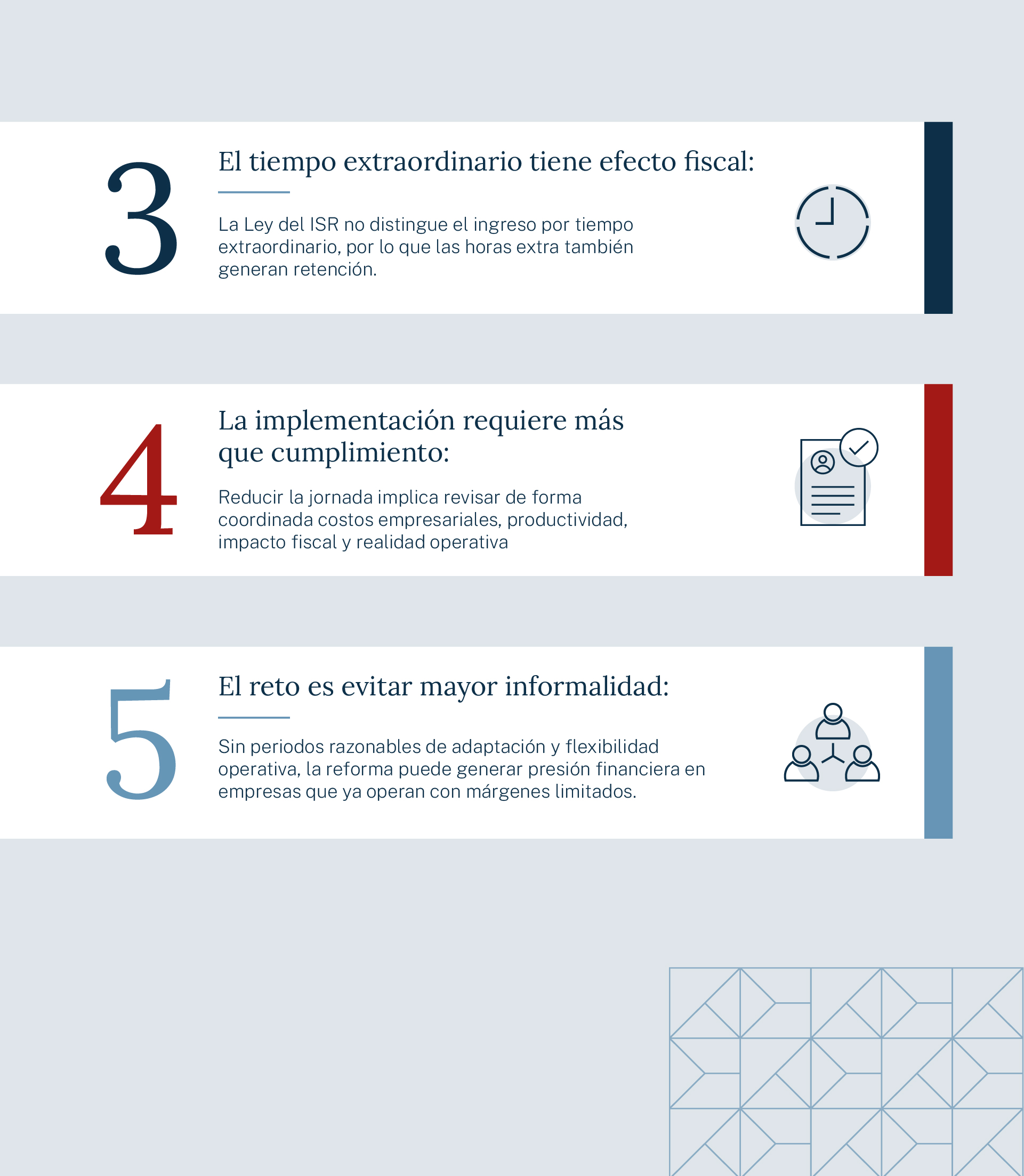
The Income Tax Law (ISR) does not distinguish income from overtime from other labor income. This means that:
In other words, an increase in overtime can create a tax effect that reduces the actual benefit received by the worker.
For this reason, the discussion regarding labor reform in Mexico must also consider its interaction with the tax system.
The transition to a 40-hour workweek in Mexico is not just a legal adjustment; it also poses a challenge in terms of business productivity.
Reducing the workweek requires a coordinated analysis of various elements within the organization:
When these factors are not analyzed comprehensively, the reform can create tension between labor protection goals and the economic viability of certain business operations.
The real challenge is not just reducing the workweek, but doing so in a way that is compatible with formal employment stability and business competitiveness.
One of the most frequent arguments to emerge within the economic analysis of labor reform in Mexico is its potential impact on informality.
When companies face significant increases in labor costs in Mexico, some organizations may find it difficult to maintain their operations within the formal framework.
In this regard, various specialists have warned that the implementation of the 40-hour workweek in Mexico must allow for reasonable adaptation periods.
As our associate Óscar de la Vega Castillo has noted:
“Micro, small, and medium-sized enterprises need an adaptation period. If we don't allow for flexibility, we will only be incentivizing informality.”
Recent data reinforces this concern. The informal employment rate in Mexico saw an approximate increase of 1.1% between December 2024 and December 2025, highlighting the labor market's sensitivity to regulatory changes.
In this context, implementing the reform requires finding a balance between labor protection and business sustainability.
While the goal of the 40-hour workweek in Mexico is to strengthen labor rights, its implementation must account for the structural characteristics of the Mexican labor market.
Companies will need to adapt their operations within an environment that combines:
A gradual implementation leading up to 2030 is intended to allow organizations to adjust their operational structures with greater foresight.
However, effective adaptation will require strategic analysis and specialized guidance to evaluate the various labor compliance scenarios.
The transition to a 40-hour workweek represents one of the most significant labor reforms in Mexico in recent decades.
Its impact goes beyond just working hours. It involves decisions that affect:
Understanding these variables is essential for organizations to anticipate risks, design adaptation strategies, and maintain stability in their labor relations.
In a constantly evolving regulatory environment, a comprehensive analysis of these factors becomes a key tool for strengthening labor compliance in Mexico and facing regulatory changes with greater certainty.






.png)