Related articles
Insights to understand the work environment, anticipate risks, and make decisions with clarity, free from noise and unnecessary jargon.
View all




The discussion surrounding the reduction of the workweek to 40 hours has become one of the most relevant topics in the Mexican labor landscape. The constitutional reform driving this change represents a profound adjustment to the traditional work organization model that has been in place for decades.
Beyond the political debate, the reform presents a clear scenario: companies must adapt to a new workweek limit that will directly impact how shifts are organized, overtime is managed, and working hours are documented.
For many organizations, the challenge will not just be reducing eight hours per week. The real challenge will lie in reorganizing time management to maintain productivity, regulatory compliance, and stable labor relations.
In this context, understanding the scope of the 40-hour workweek in Mexico becomes a strategic priority for Human Resources departments, legal departments, and compliance teams.
The legislative process that will lead to the 40-hour workweek in Mexico is in its final stage within the constitutional procedure.
Following the approval of the reform by the Congress of the Union and the majority of state legislatures, the next step is the formal tallying of these approvals and their publication in the Official Gazette of the Federation. From that moment on, the reform will be formally incorporated into the Mexican constitutional framework.
One of the central elements of the discussion has been the gradual implementation of the new workweek limit. The transition to the 40-hour workweek in Mexico is planned to be progressive through 2030, with the goal of allowing companies to adjust their operational structure without causing abrupt disruptions in the labor market.
However, the gradual nature of the reform does not eliminate the need for immediate preparation. The decisions companies make over the coming months will determine whether the transition is handled with control and foresight or under regulatory pressure.
Reducing the workweek is more than just a numerical change in working hours. Its impact reaches various elements of business operations. Key aspects that organizations in Mexico will need to analyze regarding the 40-hour workweek include:
Companies will need to review whether their operations can remain within the new weekly limit or if it will be necessary to modify shift schedules.
Sectors with continuous operations, such as manufacturing, energy, logistics, hospitality, or retail, will face specific challenges in maintaining production or service levels under the new framework.
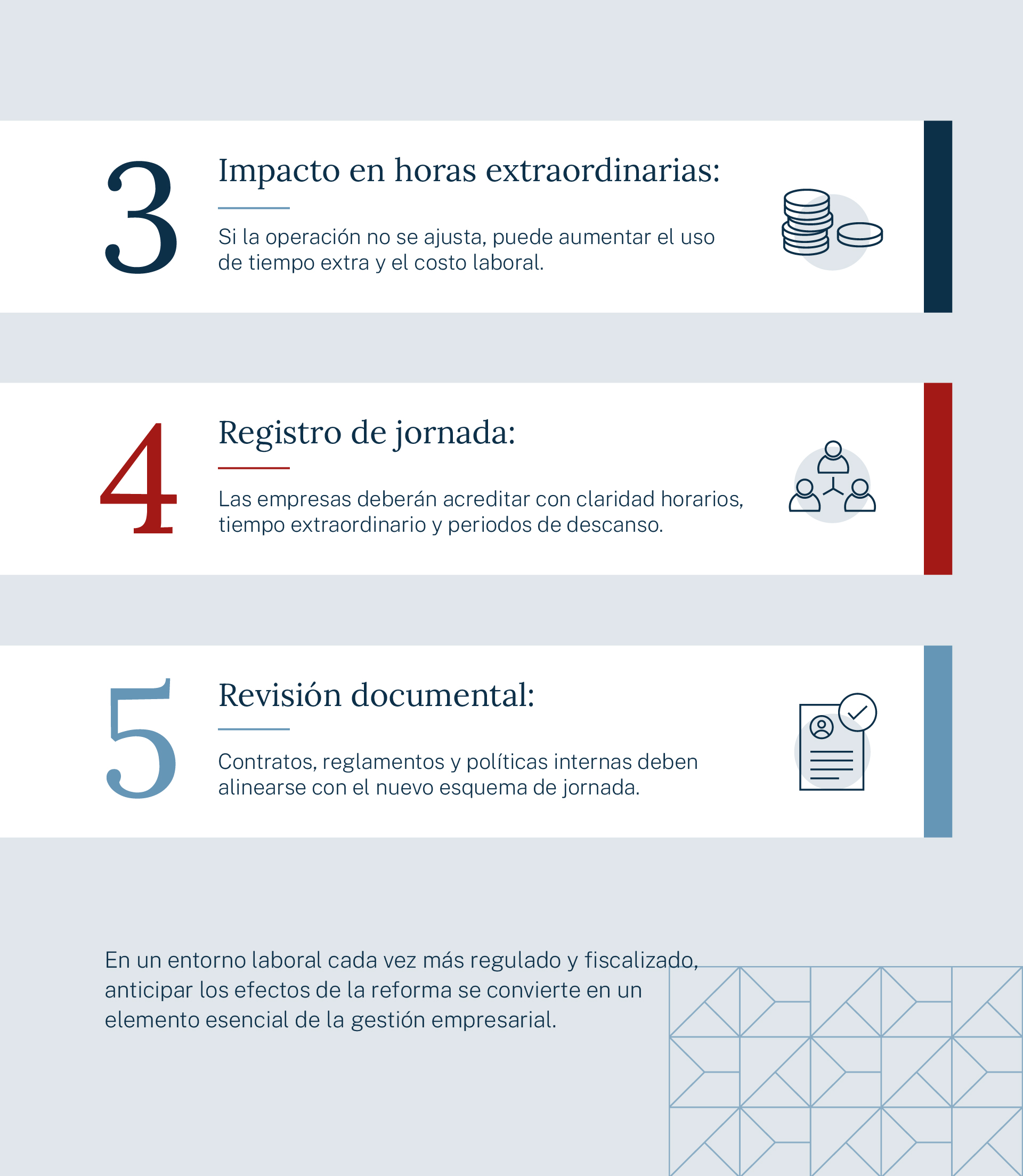
When operations are not structurally adjusted, a reduction in working hours often leads to an increased reliance on overtime.
In Mexico, overtime is paid at 200%, and at 300% once certain limits are exceeded. For this reason, constant use of overtime can lead to a significant increase in labor costs.
Proper management of overtime will be a critical factor in the implementation of the 40-hour workweek in Mexico.
Reducing working hours can put pressure on cost structures if companies need to hire additional staff or extend shifts.
In sectors with tight operating margins, these changes will require detailed financial analysis and long-term planning.
One of the least discussed aspects in public debate, yet one of the most relevant from a legal perspective, is the tracking of working hours.
The reduction in working hours will increase the importance of having reliable systems for monitoring work time.
The implementation of the 40-hour workweek in Mexico requires companies to strengthen tracking mechanisms to verify:
This point is especially relevant because, in labor proceedings, the burden of proving working hours and their payment usually falls on the employer.
Without proper documentary evidence, a company may face claims for overtime, salary discrepancies, or non-compliance regarding working hours.
Implementing a 40-hour workweek involves more than just operational adjustments. It also requires a review of the documentation governing the employment relationship within the company.
In many cases, employment contracts, internal regulations, and workplace policies were designed under the traditional 48-hour maximum workweek scheme. Failing to update these documents in a timely manner can create a disconnect between what is stated in your employment records and how work hours are actually managed within the company.
This lack of alignment can become a risk factor during labor inspections or in legal proceedings.
Individual employment contracts must accurately reflect the duration of the workday and how it is distributed throughout the week.
The transition to a new workweek limit may require adjustments to clauses related to:
When a contract does not correctly reflect these conditions, it can lead to uncertainty regarding the obligations of both parties or the calculation of overtime.
Internal work regulations govern the day-to-day organization of work within a company.
With the reduction of working hours, this document must be reviewed to ensure its provisions are consistent with how the workday is actually structured.
Key areas that often require updates include:
An outdated regulation can weaken a company's ability to prove that the workday is managed in accordance with current regulations.
In addition to formal documents, many companies operate with internal guidelines that regulate the management of working time.
These tools are key to translating legal rules into clear operational criteria for supervisors, human resources departments, and administrative staff.
Key elements to define include:
When these aspects are not clearly defined, reducing working hours can lead to operational uncertainty and increase the risk of labor disputes.
Within the Mexican labor system, documentation related to working hours is of particular importance.
In the event of a legal dispute, the burden of proving working hours and overtime payment typically falls on the employer.
For this reason, updating contracts and documentation is not merely an administrative task. It is a core element of labor risk prevention and legal defense in the event of disputes.
Experience with labor reform processes shows that the greatest risks usually arise when companies react only after regulatory changes have come into effect.
In the case of the 40-hour workweek in Mexico, an improvised implementation can lead to:
For this reason, the transition to the new labor framework must be approached as a comprehensive project that combines legal analysis, operational redesign, and document control.
Corporate preparation for the 40-hour workweek in Mexico requires a structured approach that combines legal analysis, operational assessment, and documentation adjustments. The transition should not be viewed merely as a reduction in hours, but as a change in how working time is managed within the organization.
Key actions that companies should consider include the following:
The first step is to analyze how working time is currently recorded within the company. It is essential to determine whether the time-tracking system can provide sufficient evidence of actual working hours and overtime payments in the event of an inspection or legal proceeding.
Reducing working hours may require adjustments to shift organization or the distribution of work among teams. Companies must evaluate whether their operations can be maintained within the new weekly limit or if it will be necessary to modify work schedules to avoid the constant use of overtime.
Documents governing working hours within the organization, such as individual contracts, internal regulations, and company policies, must be reviewed to ensure they accurately reflect the new working hour framework and the rules applicable to overtime.
In companies with union presence, the reduction of working hours may have implications for collective bargaining. In certain cases, it will be necessary to review collective bargaining agreements or establish agreements with union representatives to adjust the organization of working hours.
The transition to a 40-hour workweek in Mexico represents one of the most significant changes in labor regulation in decades.
Its implementation will not depend solely on the constitutional change, but on the ability of companies to adapt their work schemes, time tracking, and labor compliance.
Organizations that analyze their work schemes, time-tracking mechanisms, and contractual documentation in advance will be in a better position to face the change with stability and compliance.
In an increasingly regulated and scrutinized work environment, anticipating the effects of the reform becomes an essential element of business management.






.png)